
Nepalis will tell you they respect everyone, but their actions speak a different language.
Nepalis, in general, show very little respect for time; this practice is deeply baked into the culture. Contrary to the general understanding of what respect entails, regard for another person’s time is the most crucial demonstration of respect for them and, by extension, the value placed on their life.
The Culture of Lateness
“Nepali time” is the catchphrase Nepalis use to excuse and justify being late to anything and everything—and they are. This applies to both private and public functions, including official ones, which rarely start or end on time. Being on time, or starting and ending things on time, is the rare exception, not the rule.
At the individual level, the extent of respect shown for another’s time depends entirely on their perceived social status: their age, gender, title/position, class, ethnicity, or caste. In doing so, they demonstrate a differential respect for that person’s time and life.
The so-called leaders and people in positions of power and influence are particularly egregious offenders, often feeling entitled to their position, privileges, and therefore, to other people’s time and life. Public functions they are involved in neither start nor end on time.
Of course, this is all by design. For a high-ranking official, making a citizen or citizens wait for him (and it is more often him than her), both literally and figuratively, is essentially the strongest and most obvious form of control. This is a statement: “I control your time—not you—and by extension, I own you.”
A Legacy of Caste and Bureaucracy
Such practice is a legacy of the custom the Rana Oligarchy started during its 104-year rule. The practice was known as “Chakri,” which required the presence of high-ranking officials at public functions they themselves attended. This is partly why they care so little about the freedoms citizens are supposed to enjoy, about the rights of others, justice for others, or what constitutes an equitable society.
The incredibly time-consuming bureaucracy and institutionalized corruption set up by the ruling caste—who have helmed the country throughout its entire 250-year history—is another way those in power demonstrate their valuation of control and their lack of respect for the citizens they are supposed to serve. The caste system and the long casteist history of the country have shaped the psyche of the so-called high caste, convincing them they are superior and entitled to control others. Setting up bureaucratic systems that move at a snail’s pace and deliberately delaying major projects (if they are ever completed at all) are ways they demonstrate this contempt, clearly devaluing the time and lives of the populace.
The physical setup at every government office is a stark manifestation of this power: a mechanism of control over the people’s time. Requiring citizens to move through endless windows and rooms, often across different floors, just to get a signature, and enduring long queues at each stage, is a deliberate exercise aimed at severely limiting what citizens can accomplish with their time. That those in power refuse to change the process reaffirms this control.
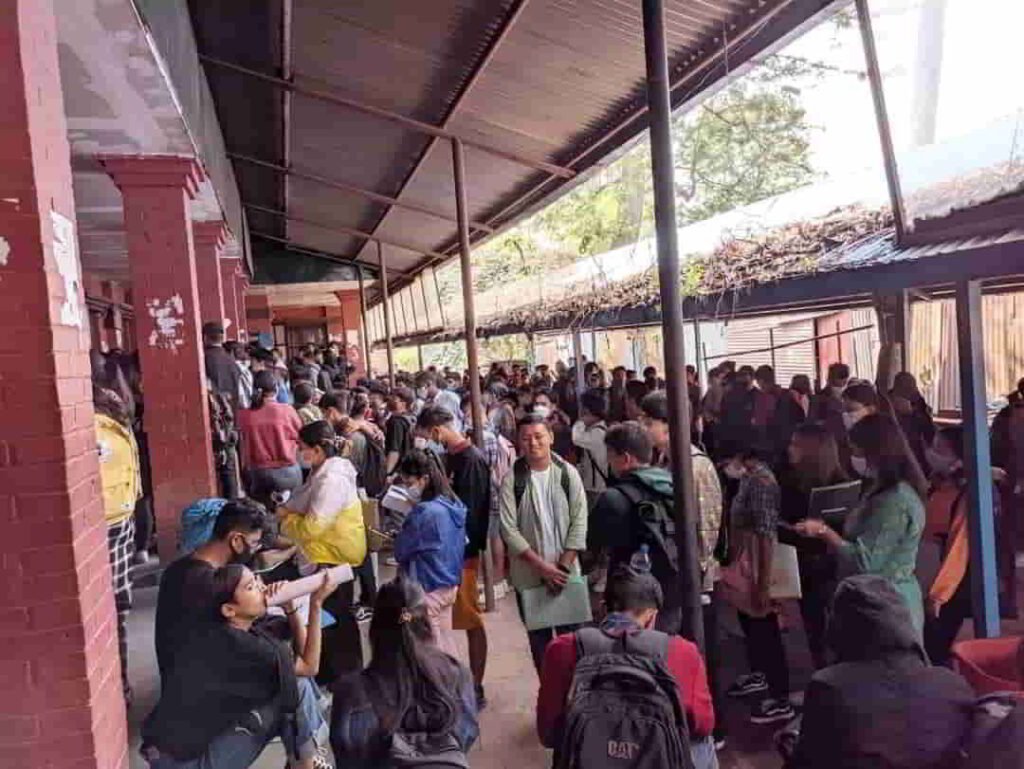
A few years ago, I discovered that the process I followed more than thirty years ago to get my No Objection Certificate (NOC), permission from the Government of Nepal to go abroad for studies, was still the one followed by the current generation of students. The process started at a branch of the Ministry of Education in Kantipath, Kathmandu, and involved visiting a couple of other offices, at least one of which was inside Singha Durbar, located more than a mile and a half away. The process was time consuming even then because of the to and fro involved and because of the way Nepali bureaucrats in general view service delivery as well as the way they treat citizens—and I was just a teenager! However, at the time the number of students going overseas for studies were limited—I encountered maybe just two others when I was going through it. It no longer is. The image below, from Shikchhya’s (शिक्षा) Facebook Post of 2022, is of students applying for their NOCs.
In contrast, the way the US Embassy in Kathmandu processes visa applications from when I applied for it for the first time in 1990 and the last time in 2019 has evolved considerably. While in 1990, I was able to just queue up briefly at the entrance, go through security screening, wait for number to be called for the interview, and walk out with the visa stamped on the passport after a brief wait following the interview, subsequent visits were different. The second visit was in 2000, third in 2014, and then the fourth and last one was in 2019. With the continual and dramatic increase in the applicants, the process in 2014 involved filing the application and picking a date for the interview online.
Why haven’t the bureaucratic processes, such as NOC application, been improved and made more effective and efficient in response to the increase in number of applicants? Because while for the US Embassy, visa-application processing is viewed as a service delivery, for Nepali bureaucrats service delivery, such as NOC application processing, is viewed as an opportunity to control and exercise their power.
Development projects—from a simple bridge to the construction of highways and major infrastructure—either take an inordinate amount of time or never get completed. While these delays stem from negligence, incompetence, and systemic corruption, they also expose their lack of regard for the time and lives of the country’s citizens.
Beyond simple delay, the systems also force citizens to engage in processes that are actively and deliberately meaningless, thereby institutionalizing disrespect for their time. During the COVID-19 pandemic, in preparation for the vaccination drive for instance, the Government of Nepal, in collaboration with UNDP and the WHO had set up an online vaccine registration process for the citizens. I duly registered as well as everyone in my family. Arriving at the vaccination site, armed with the QR code embedded with my personal details, the medical officers completely disregarded the registration details because no integrated system had been set up. My effort, time, and anticipation, as those of everyone else who must have complied, were dismissed with a careless wave, confirming that the system values mere compliance over tangible outcomes or human dignity.
The Time Divide
I am aware that the concept of time is different for Nepalis, but I also recognize that unless this changes, Nepali society will continue to insufficiently value human life and will stagnate.
In societies guided by science, time is viewed as fixed and linear; in Nepal, shaped by Hindu religious philosophy and mythology, time is viewed and treated as fluid and circular. Don’t get me wrong: the former view of time is not necessarily right and the latter necessarily wrong. Additionally, viewing and treating time as fixed and linear will not necessarily completely solve all the time-related problems faced by the society or even most, nor the issue of insufficient value placed on human life (based on gender and caste, for example).
But societies that respect time recognize the need to move with it to make progress rather than “moving it,” as Nepalis do. The result for Nepal has been to fall behind, which Nepal has done throughout its history.
The Path Forward
How can Nepalis be made to sufficiently value time, and thereby the lives of their fellow citizens? Education.
The country must raise the current rate of less than 10% of the population with tertiary education to a majority and instill a value system that places a stronger emphasis on science and data than on religious dogma and superstitions. Until and unless a significantly high percentage of Nepalis understand “If you don’t respect my time, you don’t respect me and you don’t value my life” Nepalis society will continue stumbling along in “Nepali time.”
What do you think?
PS. I got help from Google’s AI Gemini composing this blog post.
Additional Reading
- OnlineKhabar (May 23, 2024). ४६ वर्षसम्म अधुरै लुम्बिनी गुरुयोजना, तर रोकिएन जथाभावी संरचना निर्माण (Lumbini Master Plan incomplete even after 46 years, yet haphazard construction of structures has not stopped). According to the article, the original plan called for the completion in 17 years and even now it’s 14% incomplete.
- Naya Patrika (April 12, 2021). ६४ वर्षमा पनि बनेन ९० किलोमिटर सडक (Even in 64 years construction of the 90 Km road incomplete). “राजा महेन्द्रले ०१३ सालमा शिलान्यास गरेको कान्ति लोकपथ अझै अधुरो |” (Kanti Lokpath, whose foundation stone was laid by King Mahendra in 2013 BS, remains incomplete even today.)
- Naya Patrika (Jan. 14, 2021). १० वर्षमा पनि बनेन दलित छात्रावास (Even after 10 Years, Dalit Hostel Incomplete)
- Naya Patrika (April 4, 2021). बुढीगण्डकी जलविद्युत् आयोजना निर्माणका लागि उपभोक्ताबाट ५९ अर्ब कर उठाइयो, तर लगानीको मोडालिटीसमेत टुंगो लागेन (59 billion rupees in taxes were collected from consumers for the construction of the Budhigandaki Hydropower Project, yet even the investment modality has not been finalized.). “आर्थिक वर्ष ०६९/७० मा निर्माण सुरु गरेर ०७७/७८ मा सम्पन्न गर्ने लक्ष्य राखिएको आयोजनाको निर्माण कार्य अझै सुरु हुन सकेन, ६ वर्ष म्याद थपियो” (The project’s construction, which began in fiscal year 2069/70 (2012/13) with a target to complete by 2077/78 (2020/21), has still not started, and its deadline has been extended by 6 years)
- Bishal KC (Nov 21, 2025). A Unified Digital Identity for a New Nepal. “This chaos, born from a lack of “coordinated national frameworks” , has created deep data silos , crippled interoperability , and led to the “non-implementation” of the “Only Once” principle, forcing citizens to repeatedly submit the same documents to different government bodies.” Emphasis mine. [Added on Nov. 22, 2025]
My Own Writings On the Subject
- UNDP Nepal & WHO Nepal Supported MoHP Online Vaccine Registration Amounts to…NOTHING
- Where Everything Goes, Anything Goes, And Nothing Goes. Details of the six-day ordeal I had to endure in February 1999 in preparation for my travel to Australia for another round of studies.
- Destination South Korea I. Another example of officials making like of citizens difficult.
- In 2022, Ministry of Foreign Affairs upgraded the Nepali passport to E-passport and set up a system whereby citizens cold apply for their passport or for its renewal online. But of course, it didn’t work as it should as I found out. I needed to renew mine but I the platform had NO appointment dates for biometric collection for even two years down the road! And when after about two weeks of registering and failing to find an appointment date because the platform offered NONE, it deleted my application. It took almost two months from when I first initiated the process to when I actually had the passport in my hand.
- Kissing Ass Could Mean Sitting On Your Asses. The Chief Guest at the 8th 5-km Kathmandu marathon in 2014 was a minister who resided several minutes from the start venue. He arrived so late that the run started more than an hour later rendering pointless the scheduled early start time of six am to avoid the traffic. We were about three thousand runners that morning who had arrived on the premises at five. In other words, we took more time waiting on him than on the run itself.
- On The Road…Not Taken…Before…In Nepal. “More people have been killed on the roads in the last 10 years [between 2006 and 2016] than in the country’s decade-long civil war, in which an estimated 16,000 people died.”
- “To Err is Human” But to Err So is Inhumane! Air travel in Nepal is deadly and until 2018, there had been one fatal crash per year on average. And yet, the authorities wash their hands off of the issues by attributing most of them to “human error”, i.e. the pilot.





Honestly, this was a wild read. I get where you’re coming from, and you’re not wrong about how normalized lateness and slow systems are in Nepal. It doesn’t just waste time—it drains people mentally and shows how little value the system places on efficiency or accountability.
But at the same time, I feel like the issue isn’t just culture. A lot of people do respect time individually; they’re just trapped in a structure where nothing works unless you wait, push, or repeat the same task ten times. When the environment punishes efficiency, people eventually stop trying.
If Nepal wants to move forward, yeah—educating people matters. But so does fixing the institutions themselves. You can teach everyone to respect time, but if the system still runs on delays, power trips, and outdated processes, the problem won’t disappear.
Progress needs both: people who value time and a system that doesn’t treat citizens’ time like it’s disposable.
Hi Anand,
Thanks for the comment.
You said, “You can teach everyone to respect time, but if the system still runs on delays, power trips, and outdated processes, the problem won’t disappear.” If everyone has been taught to respect time, who is running the systems that runs on delays? How would people who are taught to “respect time” run “system […] on delays”? Aren’t PEOPLE running the system?
In countries where people are taught to value time, like Norway for example, systems run efficiently because people run them.