Introduction
An examination of the candidate rosters of nine political parties published by Nayapatrika for the 165 First Past The Post (FPTP) seats in the House of Representatives reveals a persistent trend in Nepali politics: the overrepresentation of historically privileged groups. Despite historical critiques of the electoral system’s tendency to favor Khas-Arya and Newar populations, the 2026 data suggests that both established and emerging political parties continue to field candidate pools that do not reflect the country’s demographic reality.
The Dominance of Khas-Arya Candidates
Across the major political platforms, Khas-Arya representation significantly exceeds the group’s proportion of the general population. For instance, “reformed” Nepali Congress fielded a candidate pools where Khas-Aryas accounted for 64% of the total—more than double their demographic share. This trend persists even within “alternative” or reform-oriented movements. The Rastriya Swatantra Party (RSP), led by Rabi Lamichhane, fielded a candidate list that was 52% Khas-Arya.
The two primary communist factions show varying degrees of this trend as per the analysis by Google’s AI Gemini:
- CPN(UML): Continues to favor Khas-Arya candidates in a plurality, if not a majority, of seats.
- CPN(MC): While Pushpa Kamal Dahal’s party did not field a Khas-Arya majority, the group still represents a plurality of their candidates. Notably, at 31%, CPN(MC) is the only major party among the top four to field a disproportionately high percentage of Adibasi/Janajati candidates (who, excluding Newars, constitute 24% of the population).
Established Parties and Traditional Agendas
The Rastriya Prajatantra Party (RPP), which advocates for the reinstatement of the sexist and casteist Shah monarchy, maintains the highest concentration of Khas-Arya candidates at 69%. Consequently, every other demographic group—including Newars and Janajatis—is underrepresented relative to their population size. Most significantly, the RPP failed to field a single Dalit candidate.
Similarly, regional parties show specific imbalances. The Madhesh-based Janata Samajbadi Party-Nepal (JSP-Nepal) fielded a candidate pool that is 58.9% Madhesi. However, despite the high Dalit population within the Madhesh region, JSP-Nepal also failed to include Dalit representation in its candidate list.
Emerging Parties and Shifts in Representation
Data from newer parties led by Janajati figures indicates a slight shift in demographic focus, though challenges remain.
- Ujyalo Nepal Party (UNP): Led by Kulman Ghising, the UNP reversed the standard trend by fielding a Janajati plurality (38%). While Khas-Aryas remain overrepresented, the party shows higher Muslim and Dalit inclusion than national counterparts.
- Shram Sanskriti Party (SSP): Led by Harka Sampang, this party is the most demographically distinct, fielding only 23.8% Khas-Arya candidates and a 51% Janajati majority. The SSP also recorded the highest Dalit representation at 10%, though this remains below the national population proportion.
The Pragatisheel Loktantric Party was the final organization for which candidate details were shared. The party’s Khas-Arya leader, Baburam Bhattarai, withdrew his candidacy and is reportedly preparing to assist the Nepali Congress in the election. The party fielded a disproportionately high percentage of candidates from the Khas-Arya and Madhesi groups but not Newars.
Break
Gender Disparity and Structural Barriers
The gender breakdown across all nine analyzed parties remains critical. Female candidates are not only few in number but also reflect the same ethnic biases seen in male candidate pools. A plurality of female candidates are Khas-Arya, while female Newars are also disproportionately represented at 9%.
Conclusion
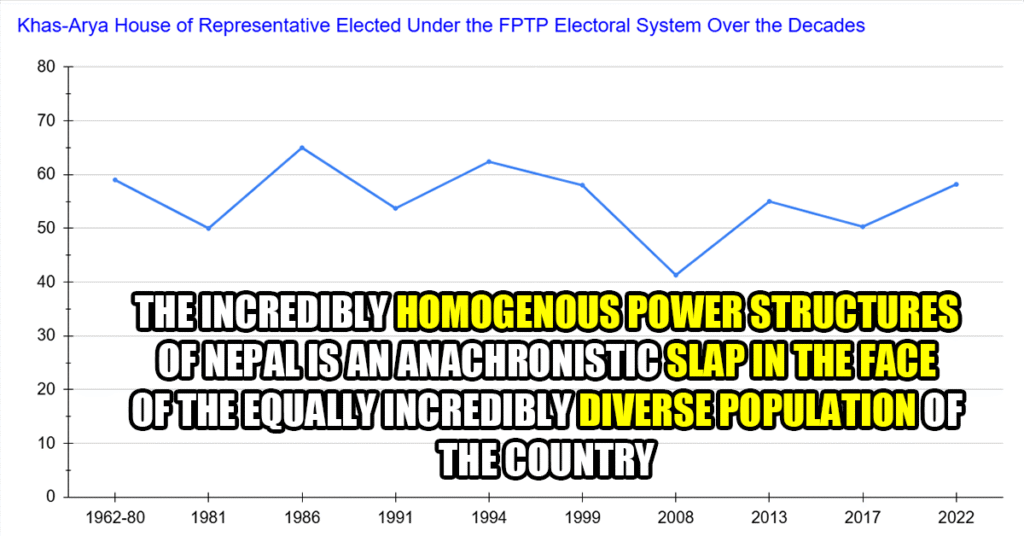
The candidate data for the nine political parties—including the most prominent ones—suggests that the results of tomorrow’s election are unlikely to deviate from historical patterns. Overall, a majority of the candidates are Khas-Arya.
Unless newer political entities can strategically lower the Khas-Arya election rate of the FPTP members to below 30%, the House of Representatives will likely retain its Khas-Arya dominance.
However, the high reported rates of voter registration (above 90%) and turnout (60% in 2022) raise analytical questions regarding the process and voter behavior. Given the logistical challenges of in-person voting on a single day on a ballot filled with symbols, and with millions residing away from their constituencies, including abroad, questions about the process remain. The consistent trend of electorates voting for candidate pools that do not reflect their own demographic or socio-economic interests could also suggest a lack of viable alternatives and/or a profound disconnect within the democratic process, or something else entirely. Regardless of whether the Legislative body is Khas-Arya dominated, given the lack of democratic norms and institutions in the governmental structures, the “musical chairs” of the executive branch is expected to continue, sustained also by a lack of robust pushback from an unevenly and selectively educated populace.
What do you think?
PS. I got help from Google’s AI Gemini drafting this blog post.