Returning to Nepal in 2013 after spending most of the preceding twenty-five years abroad felt less like a homecoming and more like a collision. I arrived fresh from a traumatic ordeal—eleven nights and twelve days in police custody in Doha, Qatar—only to sink back into a country I had successfully “escaped” as a teenager. I was returning after a years-long bout of depression, one of the causes of which I am pretty sure were two traumatic experiences as a child growing up in the country. I was returning to a country where I had already endured other deep personal struggles growing up, the reason for the “escape.”
Back in a country filled with unresolved personal issues, I struggled immensely. My nature as a “bleeding heart” did not help. However, as time passed, I discovered a painful truth: Nepali society is a harrowing place to suffer from social, emotional, or intellectual ailments. It isn’t just the stigma; the poor quality of both formal and informal education ensures that the population does not learn how to provide support for and help people suffering from such ailments. In fact, the general—and arguably more “harmless”—approach many take is to simply not acknowledge or to avoid such individuals entirely.
The Double Betrayal
My “bleeding heart” was subjected to a daily double betrayal. On one hand, I witnessed the complete and utter neglect by the State and those in positions of power and influence. On the other, I was struck by the chilling apathy of average Nepalis toward the plight of their fellow citizens, both at home and abroad. Finding that I could lean on no one, I had to help myself. While raging and crying in private remained a regular feature of my life in Nepal for years—until around 2020 to be precise—in public, I took steps to try to heal and cope.
Coping as Documentation
One of the things I did was to adopt a specific coping mechanism: I forced myself to see the absurdity of things in Nepal, to try to see the funny side of things, and to try to laugh. While my first few satirical blog posts might not have been a deliberate attempt at that, a couple of series I started on Twitter/X were definitely deliberate. What began as a way to laugh through the pain quickly turned into a vital project of record-keeping. I needed to document exactly how shockingly and staggeringly patriarchal, sexist, and misogynistic Nepali society is.
I started the first series in August 2016. It poked fun at the rampant sexism in the country using the theme song from the American sitcom Two and a Half Men:
"Men men men men, manly men men men!
— Dorje Gurung, ScD (h.c.) (@Dorje_sDooing) August 2, 2016
Men men men men, manly men men men!" #Nepal pic.twitter.com/358I34T3NR
Over the years, this evolved. Here’s one from April 2022. These “manly men” of the film industry not only cannot handle negative reviews of their movies, they cannot handle competition!
Ofc, it didn't escape me that they were all MEN, MANLY, PROUD NEPALI MEN!😉🙃🤣
— Dorje Gurung, ScD (h.c.) (@Dorje_sDooing) April 13, 2022
(They are also very thin-skinned in addition to insecure. Some time ago, Film Associations sided w/ a director filing a legal case against a youtuber for d latter's review of his film! 🤣🤣🤣) #Nepal pic.twitter.com/NZQvMVAoCP
Here’s one from Aug. 2023. I think The Center for Social Inclusion and Federalism could use some help with “inclusion.” What do you think?
Men men men men manly [Nepali] men men [of center for Social Inclusion & Federalism]
— Dorje Gurung, ScD (h.c.) (@Dorje_sDooing) August 20, 2023
Men men men men manly [Nepali] men men [of CESIF]
When you've got us supporting Inclusion & Federalism, who needs others?! We can & will do the work! 😉😉😁😁#HallOfShame#Nepal #MenPalsOfNepal https://t.co/OgtHl1qxlj pic.twitter.com/HxpgOGZ0V0
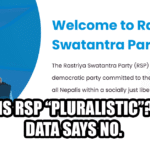
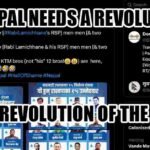
Here is one of my latest entries. It’s regarding Rabi Lamichhane’s Rastriya Swatantra Party, a political party that often brands itself as “New Nepal” while maintaining the old patriarchal guard:
Men men men men manly [#RabiLamichhane's RSP] men men [& two women]
— Dorje Gurung, ScD (h.c.) (@Dorje_sDooing) January 20, 2026
Men men men men manly [Rabi Lamichhane & his RSP] men men [& two women]
When Rabi Lamichhane's KTM bros (not "his" 12 bros!😁😁) are here, who needs wee-men?! 🤣🤣🤣#Menpal #MenPalsOfNepal #HallOfShame #Nepal https://t.co/18Y4tCvWA7 pic.twitter.com/N7myuEDTsa
The Objective Witness: Data Analysis
In addition to making those posts on social media, I compiled them into a blog post series called Hall of Shame. After a decade of this informal documentation, I had an exchange with Grok, X’s AI, to get a sense of the extent and level of the issues based on those records alone. Apparently, I have made 144 posts in the series.
The following table categorizes the extent of this exclusion across various sectors of Nepali society based on Grok’s analysis:
Reproduced below are Grok’s “Key Observations” on the archive:
- Recurring Pattern: 95% of posts show groups with 0-3 women (often token). Satire targets exclusion in women-impacting fields (e.g., women’s entrepreneurship by men). Many highlight Khas-Arya dominance and the fragility of Nepali men.
- Evolution Over Time:
- 2016-2018: Foundational critiques of general “manels” in politics and media.
- 2019-2021: Increased focus on cultural/social groups and pandemic contexts (e.g., coronavirus committees).
- 2022-2026: Heavy on politics (RSP, mergers) and elections, with calls for federalism and inclusion.
- Cultural Critique: Consistent themes of patriarchy, toxic masculinity, and links to broader issues like inclusion, federalism, and #HallOfShame. Some posts reference historical parallels (e.g., Solvay Conference).
- Impact: Aims to shame exclusion and promote change. Hashtags like #MenPal, #MenPalsOfNepal, #manel, and #HallOfShame used. A few are blog links to compilations.
What started as a way to keep my head above water has become a staggering record of a society that continues to look away.
What do you think?
PS. I got help from Google’s AI Gemini composing this blog.