The primary impediment to Nepal’s cultural, social, economic, and political evolution is a population that remains poorly, minimally, and selectively educated—a subject I have documented extensively. This educational deficit is a direct byproduct of a 250-year history defined by patriarchal and caste-based hierarchies, the legacies of which continue to stifle the nation’s progress.
I. The Historical Baseline of Exclusion
The foundational legacies of the modern state are structural discrimination and systemic casteism—practices institutionalized and entrenched by Khas-Arya leadership. Despite their significance, these subjects are rarely interrogated by politicians, the lay public, or the media. This silence is a functional consequence of the system: those in positions to facilitate reform are often the primary beneficiaries of the status quo. Historically, the deliberate under-education of the masses served as a strategic tool to preserve this hegemony.
To understand the depth of this stagnation, one must look at the earliest formation of the post-Rana government.
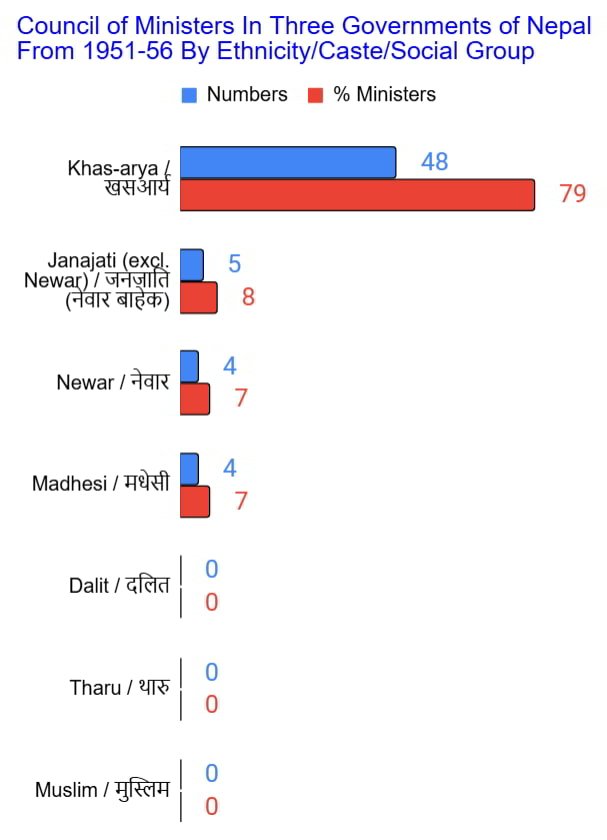
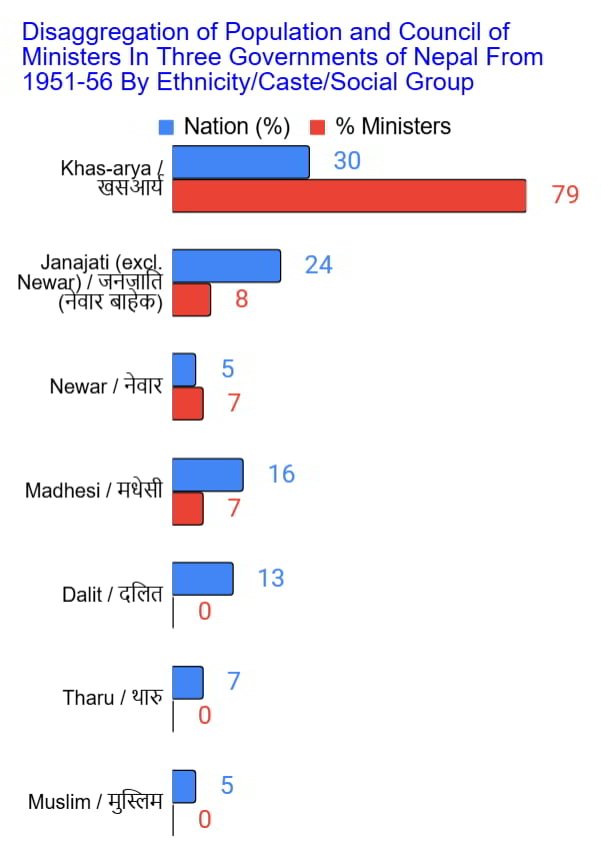
Following the fall of the Rana Oligarchs in 1951, the first three governments were entirely male. Seven decades and four generations later, the demographic composition of the nation’s most powerful offices remains remarkably unchanged.
II. Post-1990: Democratic Experimentation vs. Structural Continuity
Since the creation of the modern state, a vast majority of the Executive has been comprised of hill-origin, “high-caste” Hindu (Khas-Arya) males—with only a single exception.
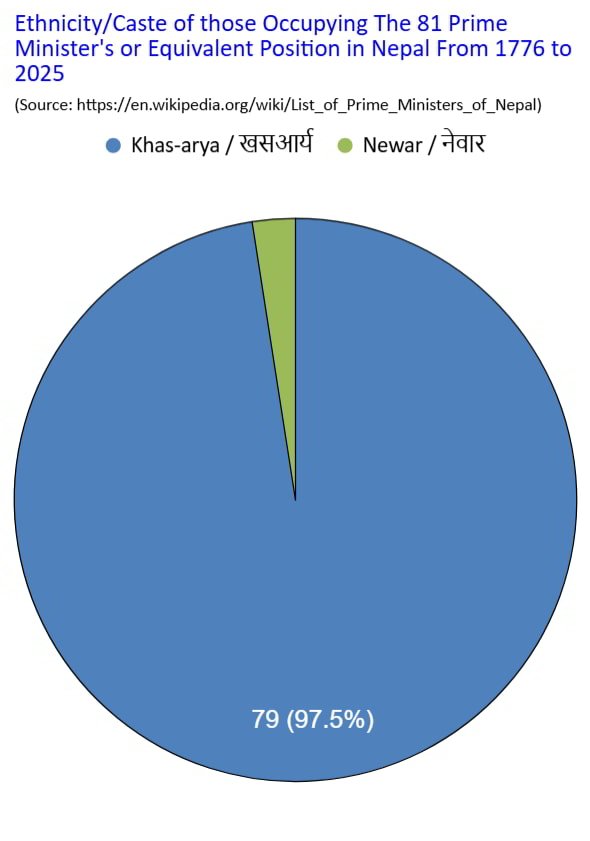
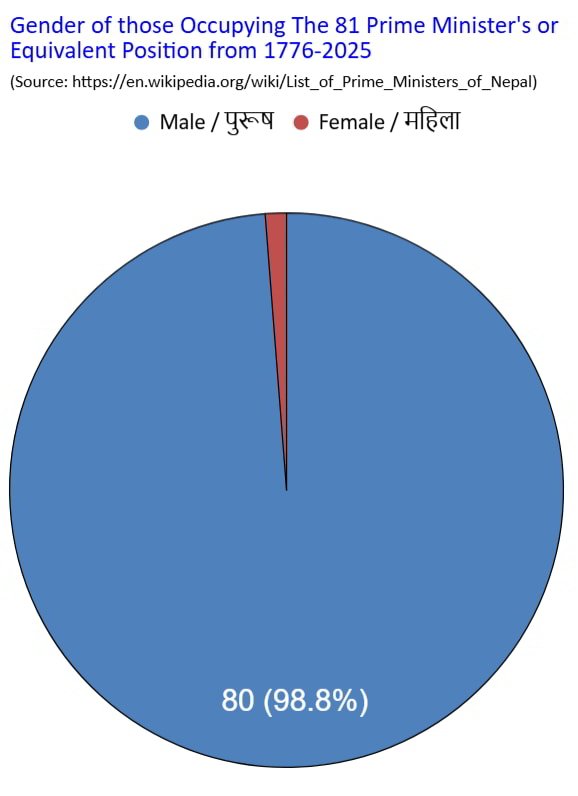
In 1990, the hereditary Shah monarchy was supplanted by a popular revolution. While this marked the beginning of Nepal’s democratic experimentation, the essential power structures remained impervious to change. Every Prime Minister since has been Khas-Arya. The only deviation in gender—the appointment of an interim female Prime Minister—did not represent a shift in ethnic representation, as she also belonged to the Khas-Arya demographic.
The political success of this group is reinforced by consolidated networks and intra-caste support systems. Consequently, Khas-Arya Prime Ministers since 1990 have consistently surrounded themselves with a cabinet that reflects their own demographic.
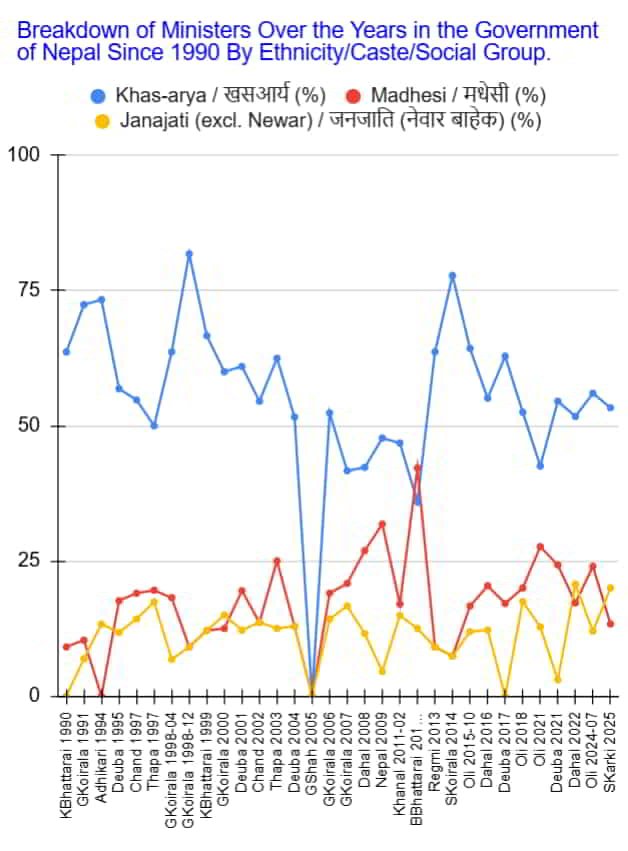
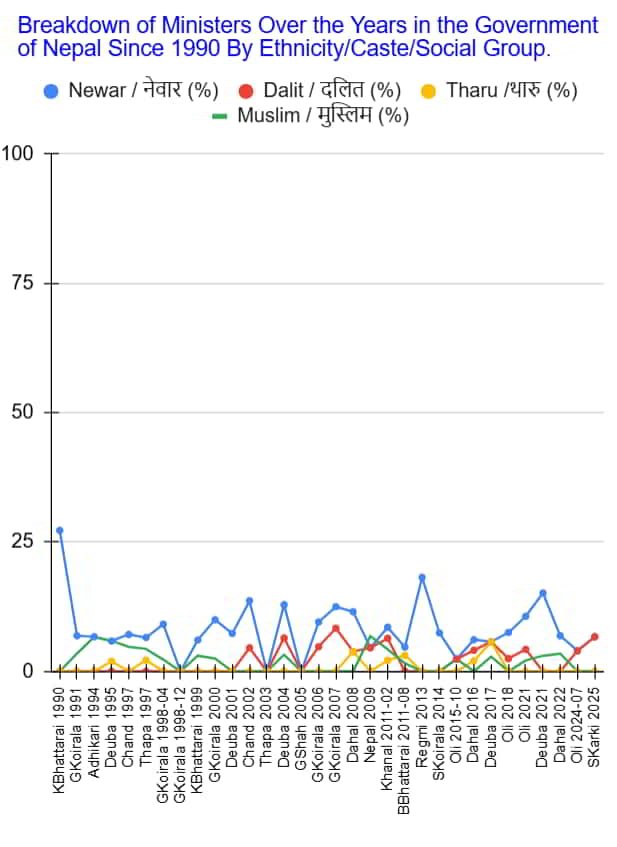
Consequently, a majority of all ministers to date have been Khas-Arya and male.
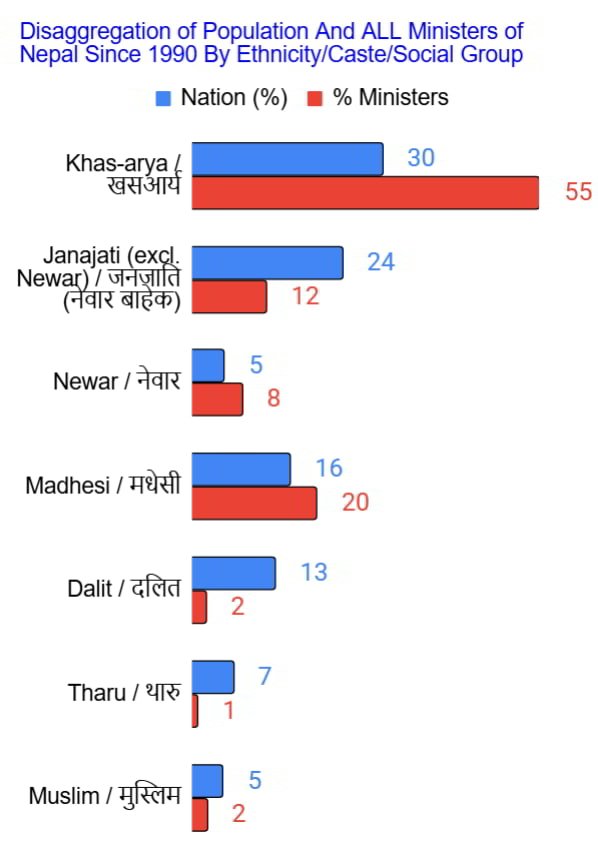
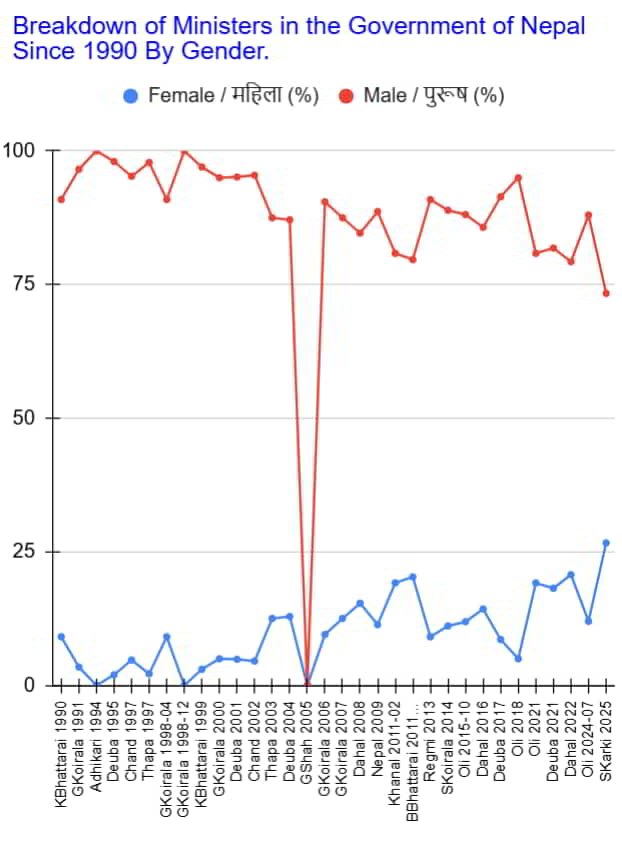
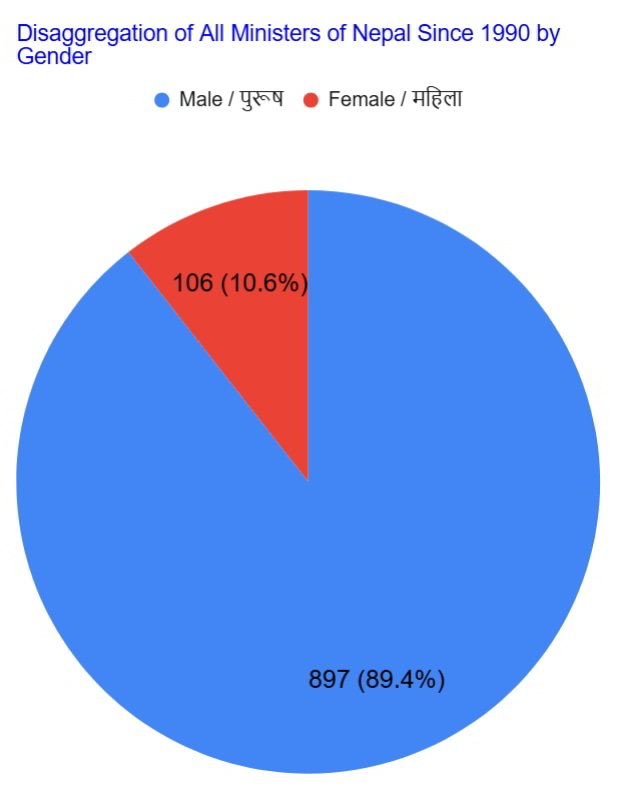
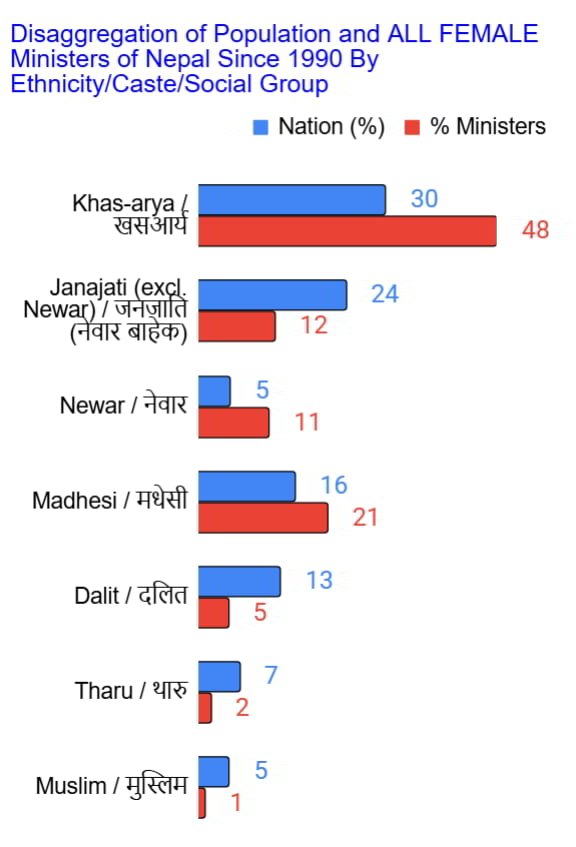
The data reveals a stark ethnic, caste, and gender disparity. If not an outright majority, a plurality of ministers in every government since 1990 have been Khas-Arya males. Only 11% of ministers have been female, and even within this small cohort, a plurality (48%) belongs to the Khas-Arya group.
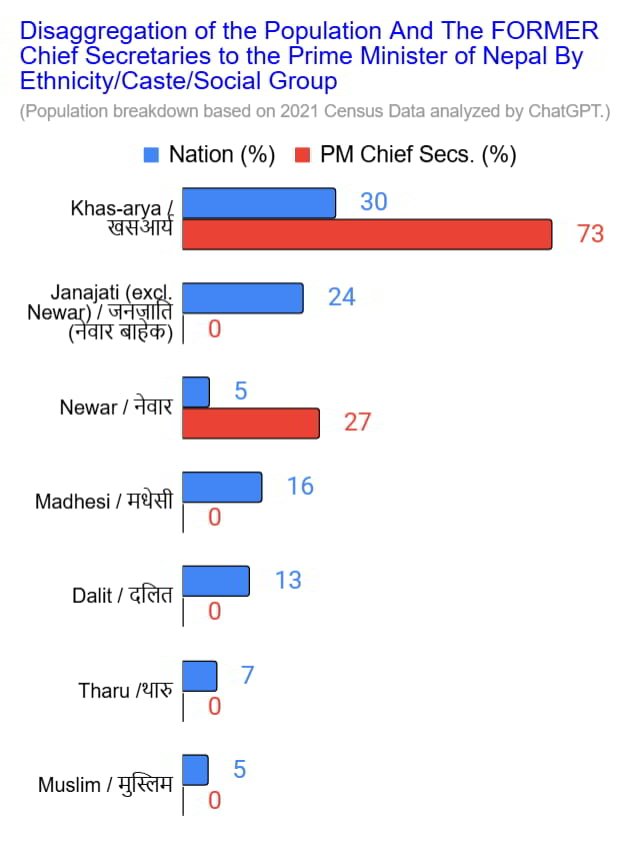
This warped structure extends beyond these primary officials into the ministerial bureaucracy. The post of Personal Secretary to the Prime Minister—historically a male-dominated role—has been effectively demographically monopolized by Khas-Aryas and Newars.
III. The 2024 Administrative Reality: The Oli Government
To assess the current state of institutional representation, one need only look at the ministerial bureaucracy under the 2024 government helmed by K.P. Sharma Oli.
Methodological Note: The following analyses are based on personnel data available on official ministry websites at the time of research. Due to inconsistent website accessibility and incomplete personnel registries, this data represents a substantial sample rather than an exhaustive census.
Secretaries are arguably the most influential actors in the state apparatus. While ministers cycle through offices frequently, Secretaries are stable, long-term civil servants who wield immense power over the nation’s most influential public institutions.
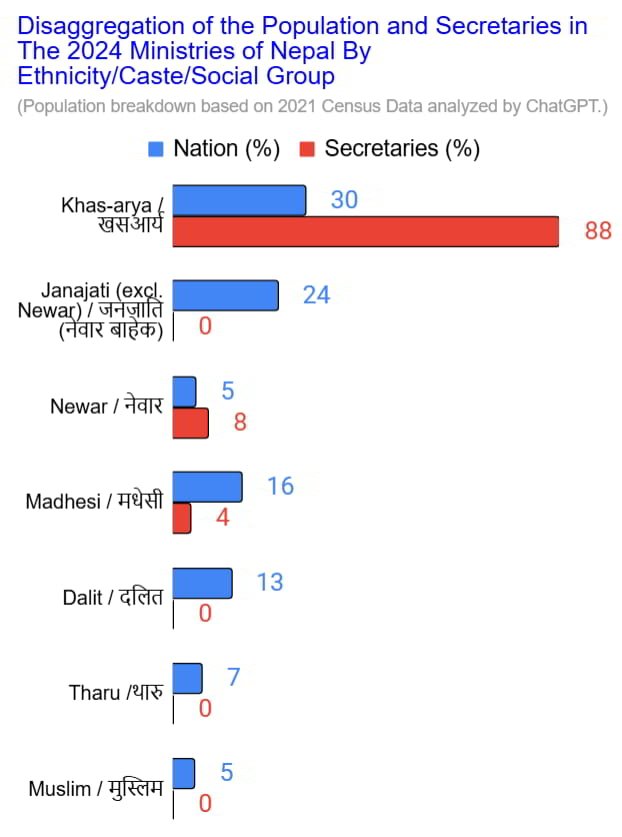
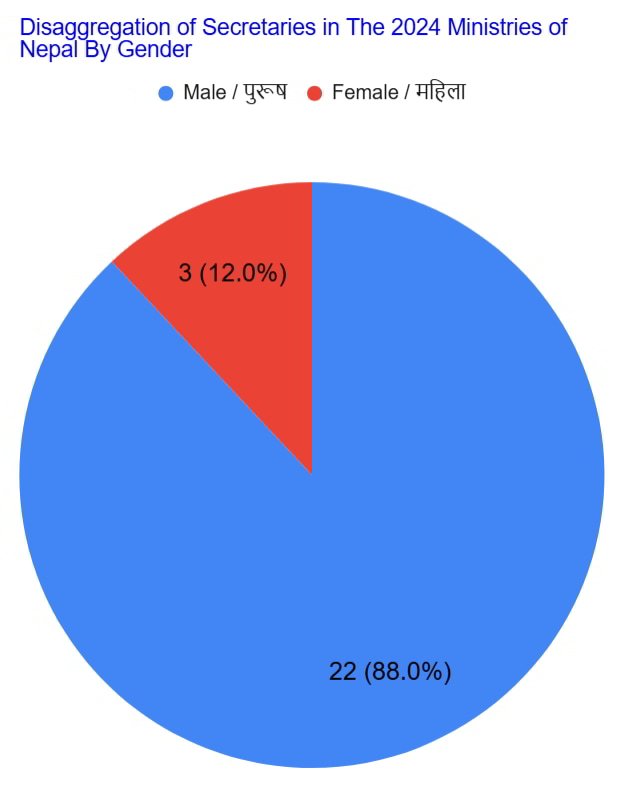
The data indicates that a majority are Khas-Aryas, and a disproportionately high percentage of Newars are also represented in the group, while several other social groups remain entirely unrepresented. Of 25 Secretaries, only three are female (representing, again, the Bahun, Chhetri, and Newar communities).
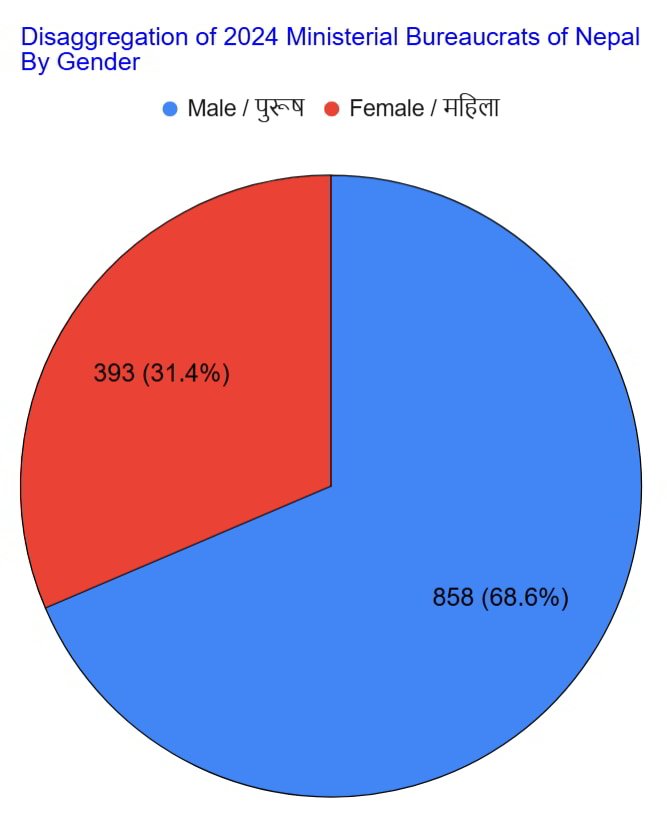
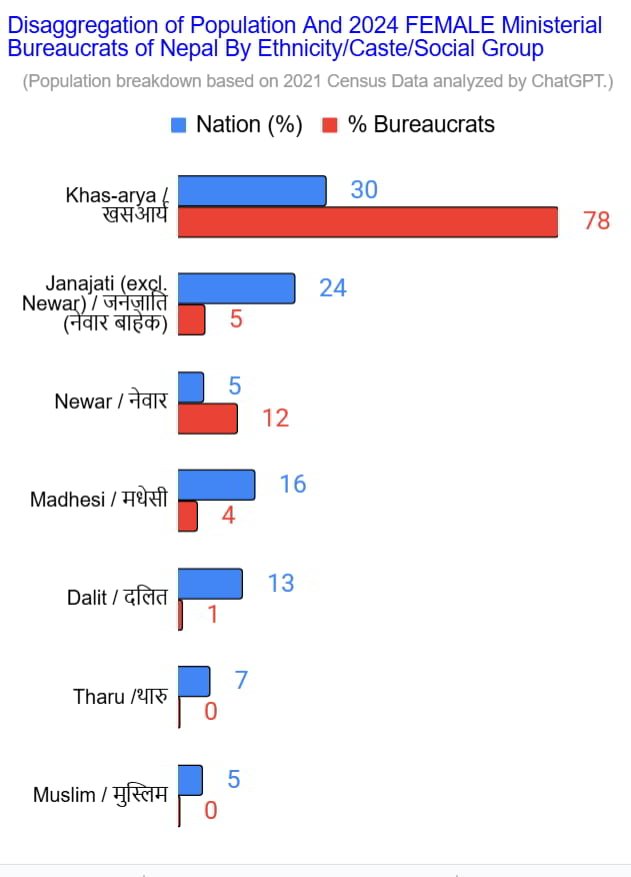
In a broader sample of 1,251 personnel across the bureaucracy, the trend of overrepresentation persists.
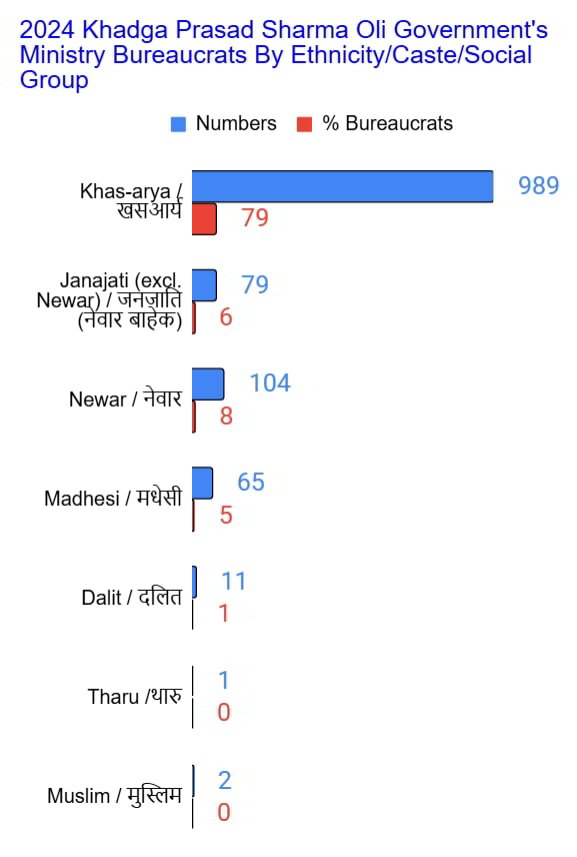
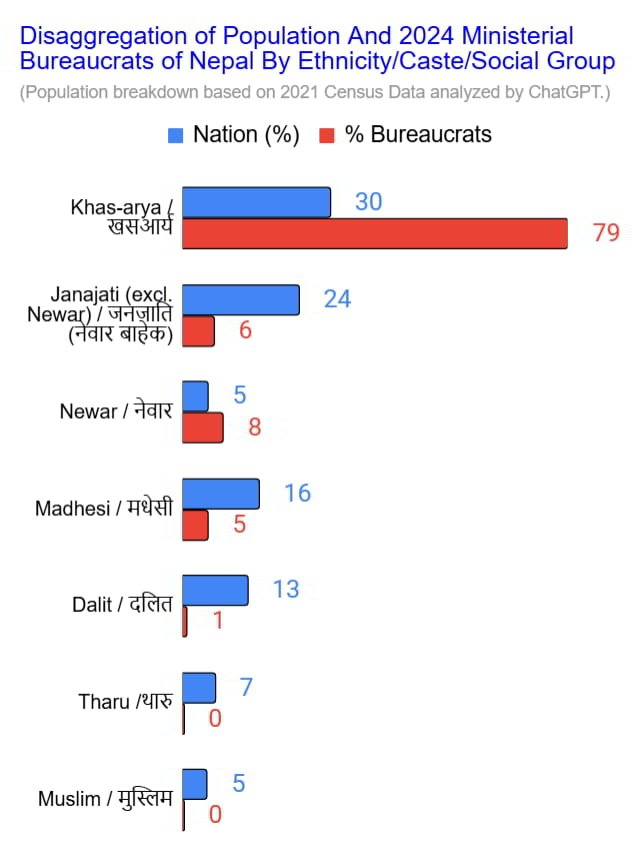
Khas-Aryas are represented at more than twice their proportion in the general population. While females constitute approximately one-third of the total personnel, their internal breakdown mirrors the broader ethnic disparity.
IV. Conclusion: The Necessity of Critical Consciousness
There is a very good reason for the appearance of political and administrative power remaining concentrated in the hand of the Khas-Arays over the last seven decades: they ensured it though structural discrimination and systemic casteism. Such concentration of power extends to the other most important pillars of democracy: the Legislative body the Judiciary, and the fourth pillar, the media, all of which are monopolized by them. Yet another powerful institution that’s been under their control is the Army.
To expect this ruling class to altruistically relinquish power or spontaneously serve the broader populace is a fallacy unsupported by historical data. On the contrary, according to their socio-religious belief system, the context and circumstances of one’s birth are viewed as a consequence of their actions in previous lives and therefore “deserved.” Within this framework, others are viewed and treated as inferior. Not surprisingly, their administrative style over the centuries and decades have demonstrated a lack of respect for the time and dignity of others. They have shown through pattern of behavior, both personal and institutional, that the lives of others are not perceived as being as valuable as their own.
The faces in the cabinet may change following the next election cycle, but the underlying power structures will find continuity unless the fundamental catalyst for change is activated.
Nothing of note will change until a significantly larger percentage of the population attains tertiary education. Tertiary education is not merely a path to employment; it is the essential mechanism that fosters the critical consciousness necessary to elucidate, critique, challenge, and dismantle institutionalized norms. According to the 1952-54 census, not even one-tenth of one percent of the population had tertiary education. After forty years of rule by autocratic Shah monarchs, that figure stood at less than 2% in 1991—the vast majority of whom were Khas-Arya and Newars. Today, it remains under 10%, while the world average stands at 28 percent.
For as long as they are able, the ruling caste will continue to keep the population poorly, minimally, and selectively educated to maintain their institutional hegemony. Mark my words.
What do you think?
PS. I got help from Google’s AI Gemini composing this blog post.
Additional Materials
Of course, many other bodies of import are monopolized by and/or spaces of import are occupied by or given to Khas-Arya men. The following are links to X/Twitter posts of mine where I point out just that.
- Oct. 2025. Ambassadors of Nepal.
- Oct. 2025, Young Nepalis as per an article in Kathmandu Post.
- Jan. 2024. Home Ministry Officials.
- Jan. 2024. Ministry of Law, Justice, & Parliamentary Affairs.
- Jan. 2024. Prime Minister Puspa Kamal Dahal’s Cabinet.
- Dec 2023. Panel Members and Speakers at Structural Reform 2.0 Policy Conclave 2023
- Nov. 2023. Nepal PhD Association central committee members.
- Sept. 2023. Teachers’ association officials.
- Aug. 2023. Nepal Planning Commission office bearers.
- Aug. 2023. Communist Party of Nepal (UML) Central Committee Members.
- Aug. 2023. Nepal Rastra Bank Board of Directors.
- Aug. 2023. Executive Council of Kathmandu University
- Aug. 2023. Executive Council of Tribhuwan University
- Jan. 2023. Candidates for the so-called Independent Student Union election at a College in Pokhara.
- Nov. 2022. Surnames of the members of the first few graduating classes of St. Xavier’s School.
- July 2021. Presidents of the national political party Nepali Congress.
- July 2021. Members of national political party Nepali Congress.
- Sept. 2021. Executives of NIC Asia Bank.
- Sept. 2020. Central Committee Members of Nepalese Blood Donor Association Australia.
- March 2020. Coronavirus Pandemic Steering Committee members.
- June 2020. Chief District Officers.
- June 2020. Inspector General of Police.
- June 2020. School teachers.