Category Social Justice

Birth is a beginning…not an end, unlike how the Caste System in Nepal treats it.

The Chameleon’s Gambit: Survival Over Substance in Nepal’s Politics
chameleon changes color and blends featimage

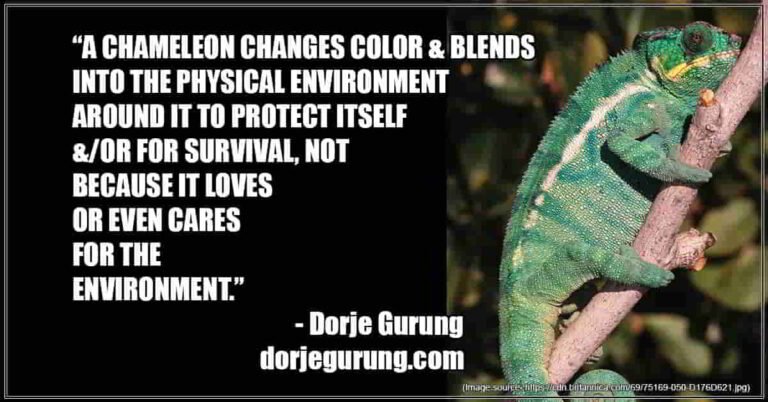
A chameleon changes color to adapt to the physical environment around it—more often than not to save itself, not because it loves the environment.

Following the September 2025 fall of the government, Nepali Congress leader Gagan Thapa successfully leveraged the 'reformer' label to seize leadership from Sher Bahadur Deuba. But while the face has changed, the soul of the party remains the same: a bastion of Khas-Arya privilege. Despite the rhetoric of a 'New Nepal,' the upcoming 2026 elections reveal a familiar reality, with over 52% of the party’s tickets handed to Khas-Arya males, leaving marginalized groups like Dalits with a near-invisible 0.6% representation.
Read MoreThe Chameleon’s Gambit: Survival Over Substance in Nepal’s Politics

The Anatomy of a Hollow Society: An Audit of Nepal’s Missing Moral Core

society hollow and deeply flawed featimage

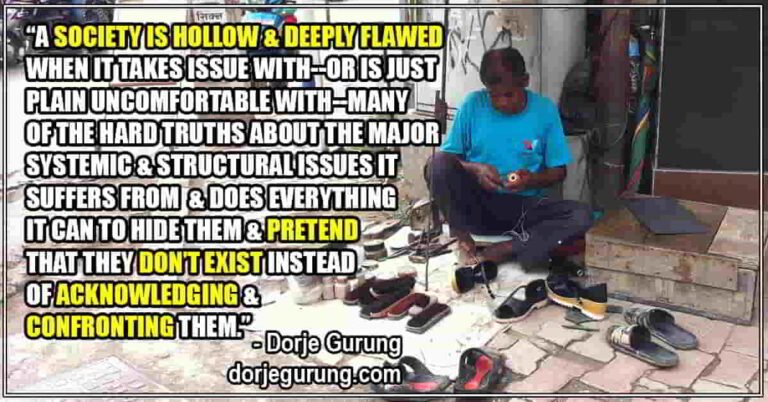
Returning to Nepal in 2013 after spending most of the preceding twenty-five years abroad, I made a few devastating discoveries about Nepali society. One was how hollow and deeply flawed it was. Struggling to recover from major personal issues, I needed to understand the details of this "hollowness" for my own sanity. Starting in late 2020, I began documenting evidence of this decay on X/Twitter. In this post, I share an analysis of those 130 documented instances to demonstrate exactly how and why Nepali society is currently lost in a state of hollow confusion.

Read MoreThe Anatomy of a Hollow Society: An Audit of Nepal’s Missing Moral Core

Manly Nepali Men or Wee-men?

manly nepali men or wee men featimage

If you are struggling with mental health issues—especially when those issues are fueled by the bleakness of the world around you—one coping mechanism is to look for the funny side of things. Doing so allows you to laugh when you might otherwise spend all your time crying.

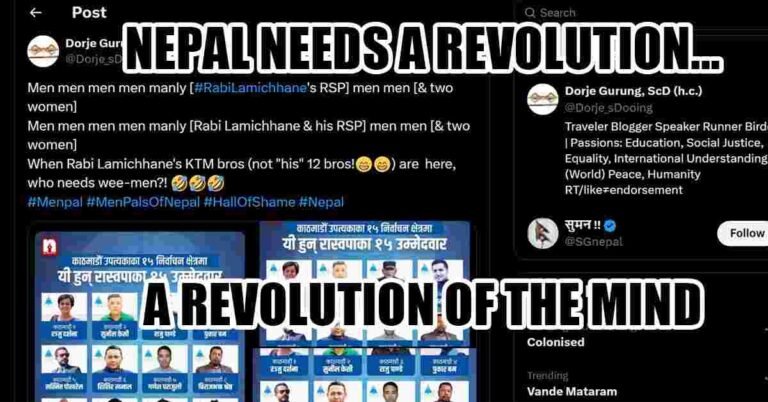
This is an account of a coping mechanism I adopted while in Nepal and how, in the process, I ended up documenting the shocking level of patriarchy and sexism that exists there.

Read MoreManly Nepali Men or Wee-men?

An Enduring Legacy: Structural Discrimination and Systemic Casteism in Nepal’s Executive Branch

the executive branch featimage

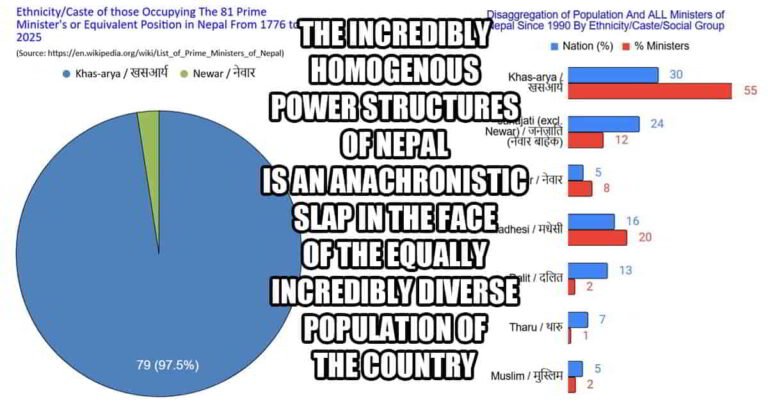
Since the formation of the modern Nepalese state via the expansion of the Gorkha kingdom approximately 250 years ago, the country has been internally colonized by hill-origin, so-called high-caste Hindu men through the poor, minimal, and selective education of the population. Consequently, all four pillars of democracy have remained monopolized by this demographic, even throughout the nation's thirty-year democratic experimentation. This data-driven analysis details their continued hegemony over the Executive branch. Until the population attains a significantly higher level of education, these entrenched power structures are unlikely to yield.

Read MoreAn Enduring Legacy: Structural Discrimination and Systemic Casteism in Nepal’s Executive Branch

The Big Fix: How Big Political Parties in Nepal Rig Elections

2022 election unholy alliance featimage

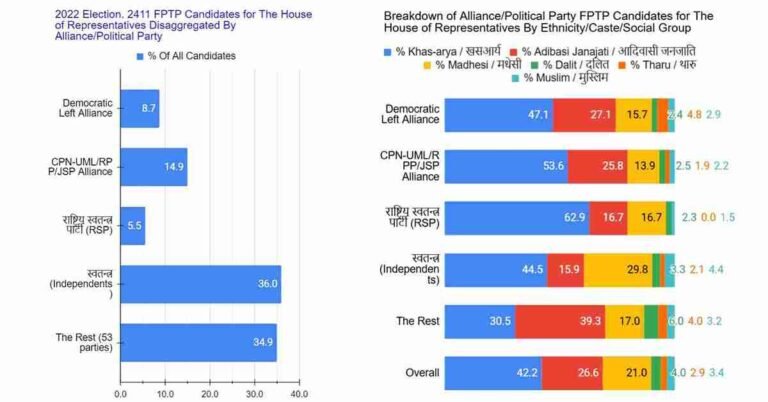
If the data is to be believed, Nepalis register for and show up to the polls in amazingly high numbers for a country where voting is restricted to a single day, must be done in person in one's constituency, and often relies on the recognition of symbols over names. While some see this as a sign of deep-rooted trust in the democratic process, that trust is tragically misplaced. The truth is simpler and far more cynical: Elections in Nepal are rigged. They are a 'Big Fix'—manufactured by national political parties to preserve the dominance of the old Khas-Arya establishment.

Read MoreThe Big Fix: How Big Political Parties in Nepal Rig Elections

How to Fight Legacies of Monarchy-Entrenched Structural Discrimination And Systemic Casteism For a More Just And Equitable Nepal

monarchy discrimination casteism legacy featimage

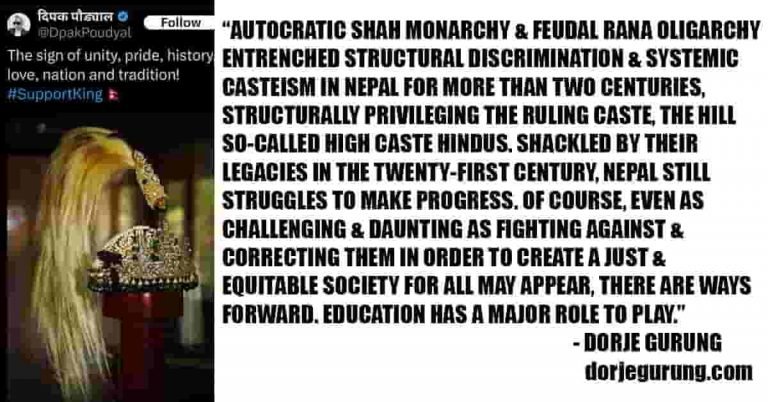
Autocratic Shah monarchy and feudal Rana oligarchy entrenched structural discrimination and systemic casteism in Nepal for more than two centuries, structurally privileging the ruling caste, the hill so-called high caste Hindus. Shackled by their legacies in the twenty-first century, Nepal still struggles to make progress. But, even as challenging and daunting as fighting against and correcting them in order to create a just and equitable Nepali society for all may appear, there are ways forward. Education has a major role to play.

In a three-post blog series, I am reproducing the answers Grok 3 provided on the subject. This one--the third and final one in the series--details the way forward.

Read MoreHow to Fight Legacies of Monarchy-Entrenched Structural Discrimination And Systemic Casteism For a More Just And Equitable Nepal