Tag structural discrimination

Political Representation in Nepal: A Statistical Evaluation of The 2026 Candidate Rosters of Select Parties
khas arya house of reps elected over the decades featimage

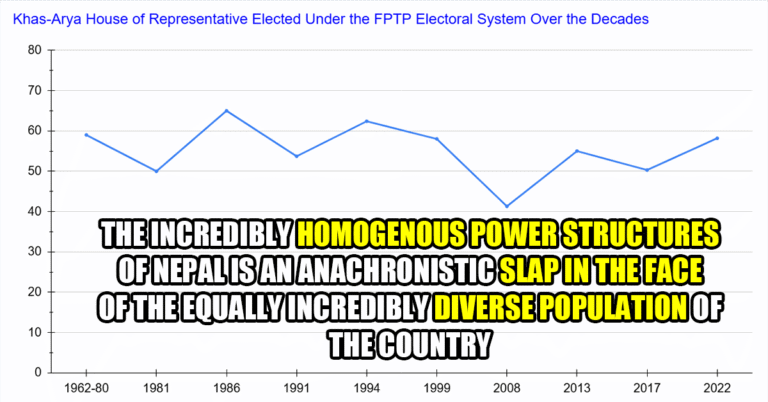
As Nepal approaches the March 5, 2026, general election for the 165 First Past The Post (FPTP) seats in the House of Representatives, an analysis of candidates fielded by nine select political parties suggests that the results are unlikely to deviate significantly from historical trends. The data indicates that the House will likely retain a Khas-Arya plurality, maintaining a demographic imbalance that has remained a persistent structural feature throughout the country’s 250-year history.

Read MorePolitical Representation in Nepal: A Statistical Evaluation of The 2026 Candidate Rosters of Select Parties

Rabi Lamichhane: The Illusion of Reform in Nepali Politics

rabi lamichhane and RSP featimage

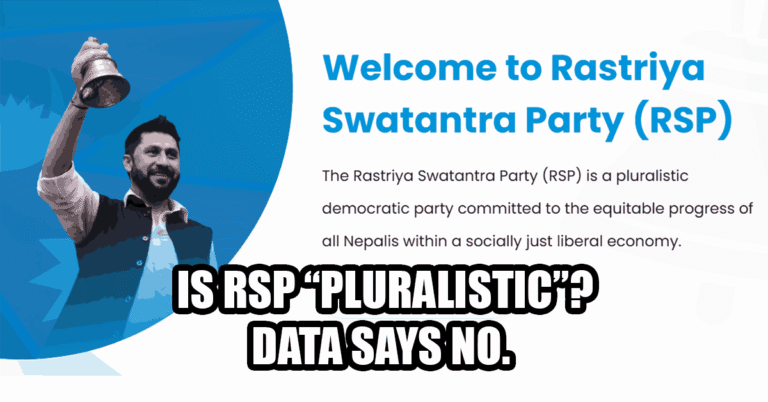
When the standard of education is abysmally low and a 200-year history of mixing politics with religion persists, the population often seeks a 'savior' to navigate systemic challenges. Rabi Lamichhane, a leader from the structurally privileged Khas-Arya demographic, has been positioned as a messianic figure. However, data indicates his party is of, for, and by Khas-Arya men—indistinguishable from the establishments the population seeks to replace. So long as educational and political awareness remains stagnant, this cycle of deification and disillusionment is likely to continue.

Read MoreRabi Lamichhane: The Illusion of Reform in Nepali Politics

The Chameleon’s Gambit: Survival Over Substance in Nepal’s Politics

chameleon changes color and blends featimage

A chameleon changes color to adapt to the physical environment around it—more often than not to save itself, not because it loves the environment.

Following the September 2025 fall of the government, Nepali Congress leader Gagan Thapa successfully leveraged the 'reformer' label to seize leadership from Sher Bahadur Deuba. But while the face has changed, the soul of the party remains the same: a bastion of Khas-Arya privilege. Despite the rhetoric of a 'New Nepal,' the upcoming 2026 elections reveal a familiar reality, with over 52% of the party’s tickets handed to Khas-Arya males, leaving marginalized groups like Dalits with a near-invisible 0.6% representation.

Read MoreThe Chameleon’s Gambit: Survival Over Substance in Nepal’s Politics

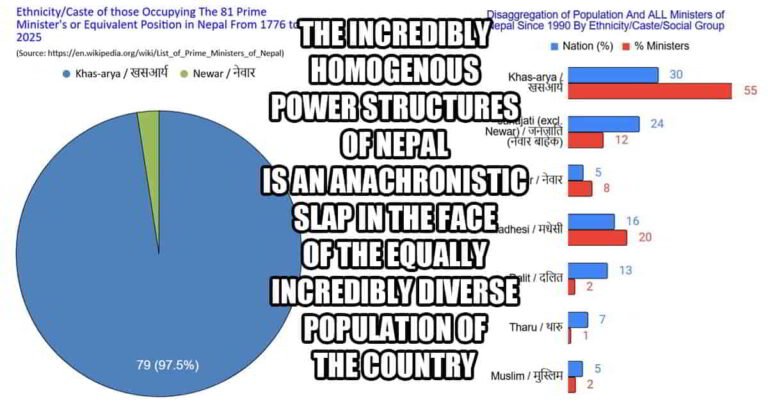
An Enduring Legacy: Structural Discrimination and Systemic Casteism in Nepal’s Executive Branch

the executive branch featimage

Since the formation of the modern Nepalese state via the expansion of the Gorkha kingdom approximately 250 years ago, the country has been internally colonized by hill-origin, so-called high-caste Hindu men through the poor, minimal, and selective education of the population. Consequently, all four pillars of democracy have remained monopolized by this demographic, even throughout the nation's thirty-year democratic experimentation. This data-driven analysis details their continued hegemony over the Executive branch. Until the population attains a significantly higher level of education, these entrenched power structures are unlikely to yield.

Read MoreAn Enduring Legacy: Structural Discrimination and Systemic Casteism in Nepal’s Executive Branch

The 2026 Mirage: Why Nepal’s Upcoming Elections Won’t Break the 250-Year Cycle

nepal is going nowhere featimage

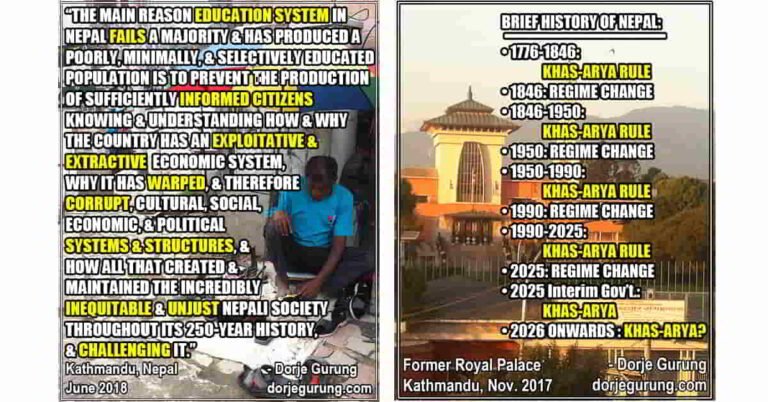
Throughout Nepal’s 250-year history, the nation has endured a persistent internal colonization by the Khas-Arya—specifically, Khas-Arya men. This hierarchy remained immutable even after the hereditary monarchy was toppled in 1990; the Khas-Arya elite simply metamorphosed from royal subjects into democratic hegemonists. The upcoming March 2026 elections fail to signal a departure from this legacy. By orchestrating a selectively educated populace, the ruling caste has ensured that the mechanisms of their power remain both unchallenged and, for many, invisible.

Read MoreThe 2026 Mirage: Why Nepal’s Upcoming Elections Won’t Break the 250-Year Cycle

A Legacy of Structural Discrimination And Systemic Casteism: The Nepal Army

population vs COAS featimage

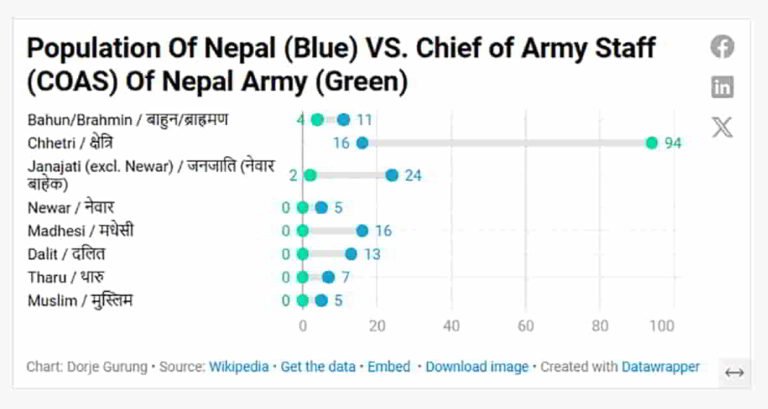
The entire history of Nepal is characterized by structural discrimination and systemic casteism, initiated by Prithvi Narayan Shah, the founder of the country. Evidence of these structures—from the highest levels of federal government to the smallest local offices—abounds, if you care to look. The Nepal Army, the institution responsible for the nation’s safety and security, is just one example. A disproportionately high percentage of those who head the institution are hill so-called 'high-caste' Hindu men.

Read MoreA Legacy of Structural Discrimination And Systemic Casteism: The Nepal Army