Home

Manly Nepali Men or Wee-men?
manly nepali men or wee-men-featimage

If you are struggling with mental health issues—especially when those issues are fueled by the bleakness of the world around you—one coping mechanism is to look for the funny side of things. Doing so allows you to laugh when you might otherwise spend all your time crying.

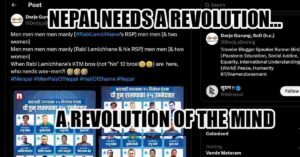
This is an account of a coping mechanism I adopted while in Nepal and how, in the process, I ended up documenting the shocking level of patriarchy and sexism that exists there.

Read MoreManly Nepali Men or Wee-men?

An Enduring Legacy: Structural Discrimination and Systemic Casteism in Nepal’s Executive Branch

the executive branch-featimage

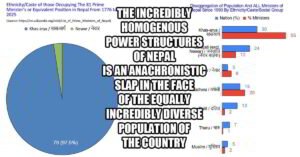
Since the formation of the modern Nepalese state via the expansion of the Gorkha kingdom approximately 250 years ago, the country has been internally colonized by hill-origin, so-called high-caste Hindu men through the poor, minimal, and selective education of the population. Consequently, all four pillars of democracy have remained monopolized by this demographic, even throughout the nation's thirty-year democratic experimentation. This data-driven analysis details their continued hegemony over the Executive branch. Until the population attains a significantly higher level of education, these entrenched power structures are unlikely to yield.

Read MoreAn Enduring Legacy: Structural Discrimination and Systemic Casteism in Nepal’s Executive Branch

Transcendence: Why I Had to Leave Nepal to Find My Humanity

travel and transcendance-featimage

Driven by the sting of childhood discrimination, I sought to "escape" Nepal at a young age. Over two decades of living and working across the globe transformed me, allowing me to find a sense of humanity that transcends borders. I finally broke free from the cultural constraints that tried to define my potential, discovering that I am a human being first and a nationality second.

Read MoreTranscendence: Why I Had to Leave Nepal to Find My Humanity

The Big Fix: How Big Political Parties in Nepal Rig Elections

2022 election unholy alliance-featimage

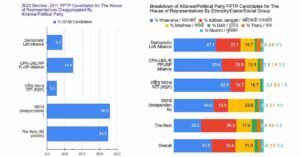
If the data is to be believed, Nepalis register for and show up to the polls in amazingly high numbers for a country where voting is restricted to a single day, must be done in person in one's constituency, and often relies on the recognition of symbols over names. While some see this as a sign of deep-rooted trust in the democratic process, that trust is tragically misplaced. The truth is simpler and far more cynical: Elections in Nepal are rigged. They are a 'Big Fix'—manufactured by national political parties to preserve the dominance of the old Khas-Arya establishment.

Read MoreThe Big Fix: How Big Political Parties in Nepal Rig Elections

The 2026 Mirage: Why Nepal’s Upcoming Elections Won’t Break the 250-Year Cycle

nepal is going nowhere-featimage

Throughout Nepal’s 250-year history, the nation has endured a persistent internal colonization by the Khas-Arya—specifically, Khas-Arya men. This hierarchy remained immutable even after the hereditary monarchy was toppled in 1990; the Khas-Arya elite simply metamorphosed from royal subjects into democratic hegemonists. The upcoming March 2026 elections fail to signal a departure from this legacy. By orchestrating a selectively educated populace, the ruling caste has ensured that the mechanisms of their power remain both unchallenged and, for many, invisible.

Read MoreThe 2026 Mirage: Why Nepal’s Upcoming Elections Won’t Break the 250-Year Cycle

A Legacy of Structural Discrimination And Systemic Casteism: The Nepal Army

population vs COAS-featimage

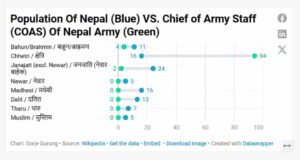
The entire history of Nepal is characterized by structural discrimination and systemic casteism, initiated by Prithvi Narayan Shah, the founder of the country. Evidence of these structures—from the highest levels of federal government to the smallest local offices—abounds, if you care to look. The Nepal Army, the institution responsible for the nation’s safety and security, is just one example. A disproportionately high percentage of those who head the institution are hill so-called 'high-caste' Hindu men.

Read MoreA Legacy of Structural Discrimination And Systemic Casteism: The Nepal Army